Getting Started
Begin your Métis family research journey with these foundational steps
Start With What You Know
The best place to begin is with yourself. Write down your full name, date and place of birth, and do the same for your parents, grandparents, and as far back as you can go from memory. Don't worry about filling in every detail right away — you're just creating a starting point.
Include:
- Full names (including maiden names)
- Birth, marriage, and death dates
- Places of residence
- Family stories mentioning Métis ancestry
Quick Start Template
You → Parents → GrandparentsNames, dates, places
Any family stories or traditions
Interviewing Family Members
Talk to your relatives — especially older ones — as soon as you can. Memories fade and knowledge is lost when people pass on.
Ask Open-Ended Questions:
- Who were your grandparents?
- Did anyone in the family speak a different language?
- Were there any stories about Indigenous or fur trade connections?
- Where did our family live when you were growing up?
- What work did your ancestors do?
- Do you remember any unusual family traditions?
- Were there any family members who lived 'on the land'?
Need Help with Interview Questions?
- Use our suggested list of questions to guide conversations with your family members.
- Download the questions in your preferred format:
- Interview Questions (PDF)
- Interview Questions (DOC)
- Feel free to customize and adapt the questions to fit your family's unique story and needs.
Interview Tips
- Record interviews (with permission)
- Take detailed notes
- Listen for place names
- Note unusual surnames
- Ask about people who lived "on the land"
- Listen for Hudson's Bay Company connections
Listen For Clues:
• Mentions of missions• References to "the land"
• Hudson's Bay Company work
• French or Indigenous names
• Stories about moving frequently
Gathering Family Records
Search through family documents and artifacts for valuable genealogical clues.
Home Sources
- Family Bibles
- Old letters or diaries
- Photographs with captions
- Marriage certificates
- Baptism certificates
Official Documents
- Obituaries
- Land titles
- Military records
- Employment records
- Immigration papers
Special Finds
• St. Boniface baptism records
• Scrip affidavits
• Homestead patents
• HBC employment records
Preservation Tips
Scan or photograph everything you find, and label it clearly. Keep both digital and physical copies in a safe place. Documents dating before 1900 can be especially valuable evidence.
Family Records Tracking Example
Use a tracking system like this to organize your findings. Download our template to get started:
| Category | Item | Person/Relative | Location | Date Found | Notes | Scanned? | To Do |
|---|---|---|---|---|---|---|---|
| Home Sources | Family Bible | Aunt Marie | Duck Lake, SK | 2025-07-08 | Lists births/deaths 1890-1950 | No | Request scan |
| Home Sources | Old Letters | Cousin Thomas | Winnipeg, MB | 2025-06-15 | Letter from Pierre Beaulieu, 1921 | Yes | Transcribe contents |
| Official Docs | Baptism Certificate | Self | Surrey, BC | 2025-05-02 | St. Laurent Parish, 1980 | Yes | — |
| Official Docs | Marriage Certificate | Grandma Joan | Calgary, AB | 2025-06-01 | Marriage at Batoche, 1945 | No | Request photo copy |
| Special Finds | Scrip Affidavit | — | HBCA Archives | — | Pierre Beaulieu, 1885, Red River | — | Locate and photograph |
| Home Sources | Photograph Album | Uncle Robert | Edmonton, AB | 2025-04-20 | Photos with handwritten captions | No | Arrange visit to scan |
| Official Docs | Military Records | — | LAC, Ottawa | — | WWI record: Joseph Beaulieu, 1916 | — | Order copy from LAC |
| Official Docs | Land Title | — | Provincial Archives | — | Homestead record: St. Laurent area | — | Request copy |
Creating a Simple Family Tree
Use paper if that's easiest, or try free online tools to organize your findings.
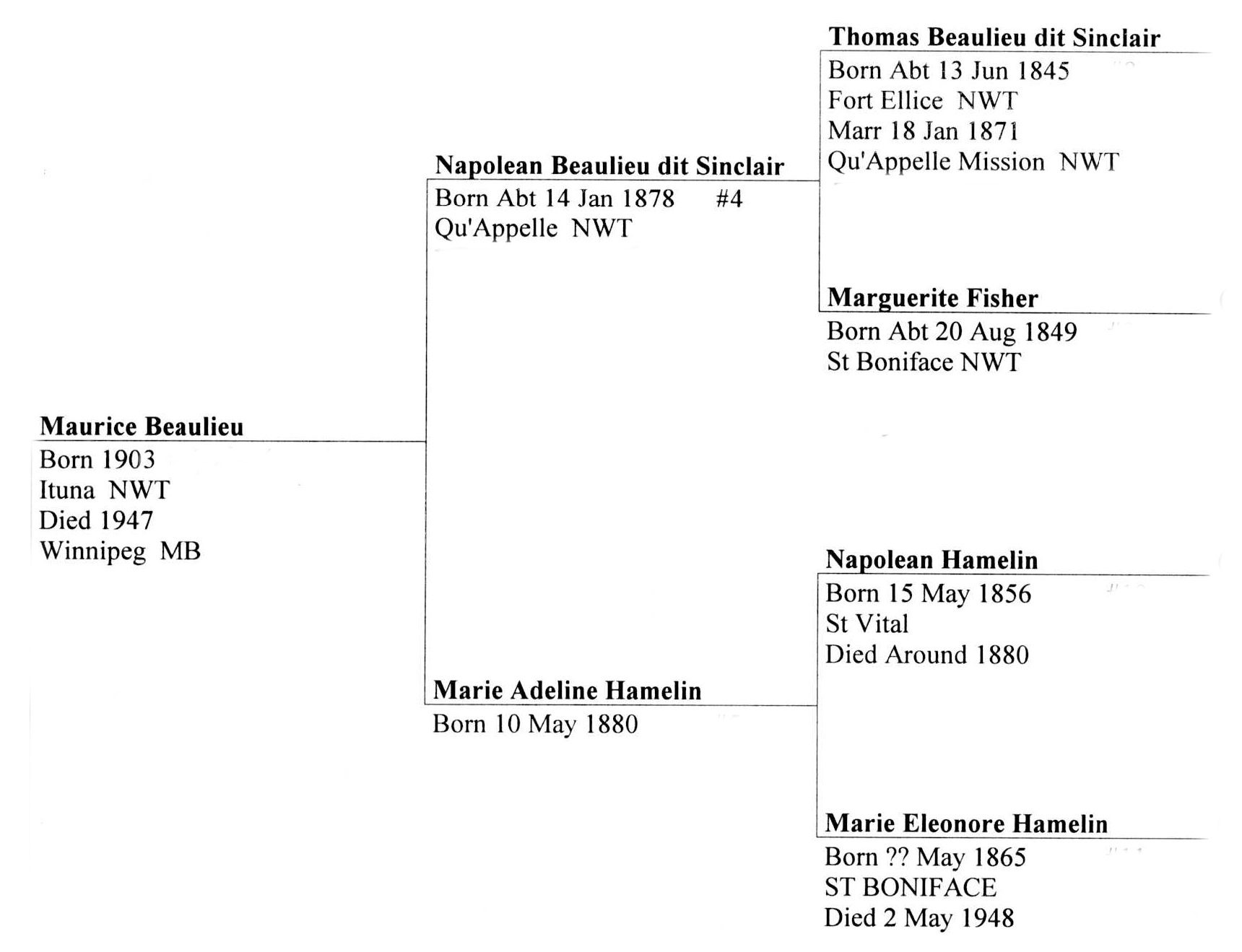
Example of a simple family tree structure to help organize your findings
Recommended Tools
Getting Started Tips
- Don't worry about being perfect
- You can revise as you find new information
- Focus on organizing what you know
- Look for visual patterns in your tree
Example Pattern to Look For:
French surname + Red River location = Potential Métis connection worth investigatingTip: Focus Narrowly at First
Start with one line — say, your maternal grandfather's family — rather than trying to trace every branch at once. This keeps things manageable and makes it easier to spot patterns or gaps in the records.
Coming Next: Understanding Métis Identity and Definitions
Once you've started gathering names and stories, it's important to understand how Métis identity is defined — historically, culturally, and legally. Section 3 will guide you through the differences between ancestry and identity, and how to approach this work with respect for Métis communities and traditions.